AI Quiz Generator: How It Works and Where It Fails
Most write-ups of this stop at “type a topic, get questions.” That part is true and takes one sentence. What follows is the rest of it: what the model is actually asked for, the two settings that decide whether the result is usable, and the four ways it still gets things wrong.
TL;DR
- You give it a topic, not a document. It writes questions from what the model already knows.
- Reasoning mode made it 19× slower for no gain. Turning it off took a round from 128 seconds to under seven.
- Left alone, it repeats itself. Two things stop that: a raised temperature and a list of what it has already used.
- It still writes the occasional question with two right answers. Read the round before you play it.
What it actually does with your topic
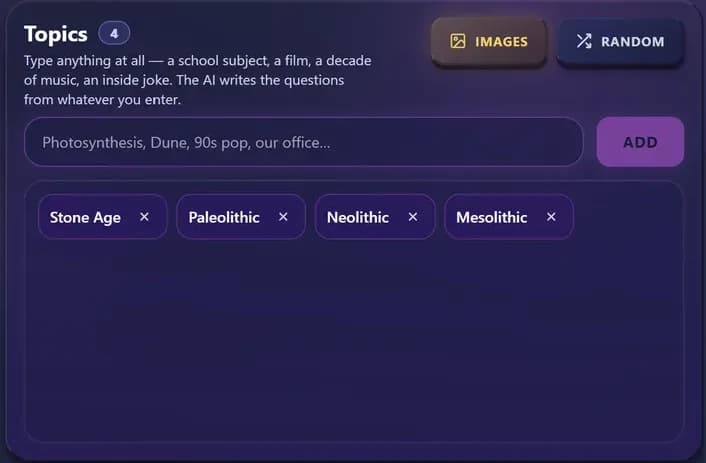
You type something — Photosynthesis, Dune, 90s pop, our office — and a model is asked to return a fixed number of questions on it, each with four options, one marked correct, a difficulty, and a one-line explanation of why the answer is right.
The important word is topic, not source. Nothing is retrieved and nothing is read. The questions come from what the model absorbed in training, which is why it is excellent on the Roman Empire and unreliable on last month's news. If you need questions drawn strictly from a document you supply, an AI quiz generator of this shape is the wrong tool — it will happily write plausible questions your document does not support.
The slow version, and why it was slow
Current models can be asked to reason before answering — to think through the problem in a hidden scratchpad first. For most hard tasks this is a real improvement. For writing quiz questions it was a disaster, and the numbers are worth stating exactly.
That gap was the entire wait. Not the prompt length, not the number of questions, not a lack of parallelism — each of those was measured and ruled out before the real cause was found. It is the sort of thing worth knowing if you are building this yourself: the slowest part of an AI quiz generator is usually not the part you would guess.
Turning it off is not free, though. Which is the next problem.
Why it wants to give you the same quiz twice
Without reasoning, the model converges. Ask it for the Roman Empire and it goes to Caesar, the Colosseum and Vesuvius — the same three a second time, and a third. This is the single most common complaint about every AI quiz generator, and it is not a bug so much as the default behaviour of the thing.
Two counterweights, both paid for in the request rather than in waiting:
- A higher sampling temperature. Measured across five rounds of eight: at 0.8 the model produced 28 distinct questions out of 40; at 1.1 it produced 40 out of 40, with no increase in malformed output. Pushing further backfires — at 1.4 rounds started coming back short and broken.
- An explicit list of what it has already used. Every subject already covered is sent back with the next request, with an instruction not to reuse it, rephrase it, or reach for a synonym of it.
If you are evaluating tools, this is the thing to test. Generate the same topic three times. A generator that hands you the same round each time will bore a room by the second game, and no amount of interface polish fixes it.
Four things it still gets wrong
These are not reasons to avoid AI-written questions. They are the reasons to spend thirty seconds reading a round before you put it in front of people.
It repeats itself
Ask for "the Roman Empire" twice and the second round is Caesar, Colosseum, Vesuvius all over again.
A language model asked for a famous subject reaches for the most famous one, every time. Nothing about the request is random, so nothing about the answer is either.
It writes questions with two right answers
"Which of these is a mammal?" with both a whale and a bat among the options.
The model writes the correct answer first and the wrong ones second, and it does not always check the wrong ones hard enough. This is the failure that actually ruins a game, because the room argues and the host has no ruling.
It leaks the answer into the question
A question that names the thing it is asking you to name, or four options where only one is the right length.
Wording and plausibility are separate skills. The model is better at the first than the second, so a distractor that is obviously filler is common.
It is confident about the recent past
Anything from the last year or two: current office-holders, latest releases, who won what.
Training data has an end date and the model does not reliably know where it is. For a quiz night this is mostly harmless; for a classroom it is the one category worth avoiding.
Two things that make a generated round survivable
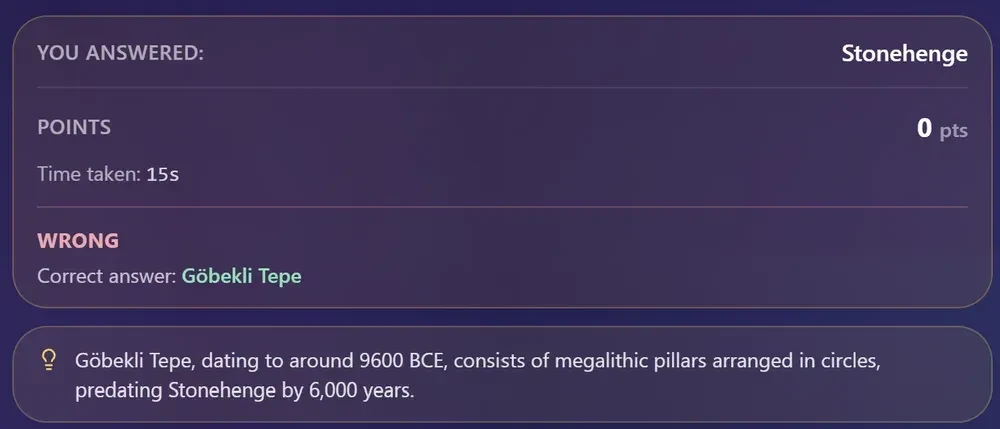
An explanation on every reveal. One sentence on why the answer is right, written at the same time as the question. It settles the argument at the table, and it is the fastest way for a host to spot a question the model got wrong — a bad explanation is much more obvious than a bad question.
A picture, when the subject has one. Alongside each question the model names the entity worth illustrating, which is looked up in Wikimedia Commons. That name is deliberately separate from the topic label: the label is a short editorial phrase like “Parliament seat quirks”, which matches no encyclopaedia article, while the illustration needs a real one.
One model, on purpose
Questions here are written by DeepSeek, and there is no fallback to a second provider. That is a deliberate reversal: an earlier version tried several in sequence, and when one of them retired the model it was being asked for, the chain swallowed the error and quietly billed the next one instead. Nobody noticed for weeks.
A fallback chain converts a loud failure into a silent, expensive one. With a single provider, a generation failure looks like a generation failure — which is worth more than the uptime the chain was supposed to buy.
Questions people ask
Is there a genuinely free AI quiz generator?
Quiz8 generates questions with AI on the free plan, with no card and no trial window: you type a topic, it writes the round, and up to 42 people can play it. Image questions are free too; Pro adds ad-free play and event and history tools. What is free is the generation itself, not a limited preview of it.
How long does it take to generate a quiz?
Under seven seconds for a round of eight questions, with the first question arriving in about one second. That number is the result of turning reasoning mode off — with it on, the same prompt took 128 seconds and produced 55,204 characters of internal reasoning nobody would ever read.
Can it generate questions from my own text?
Not from a pasted document. It takes a topic — a phrase, a subject, a film, an inside joke — and writes questions about it from what the model already knows. If you need questions drawn strictly from a specific source text, this is not the right tool and you will get plausible-sounding questions your source does not support.
Are the questions actually accurate?
Mostly, and not always. The common failures are a question with two defensible answers and overconfidence about the last year or two. Both are worth a thirty-second read-through before you play, which is why every question shows a one-line explanation of why the answer is right at the reveal — it is the fastest way to catch a bad one.
Which model writes the questions?
DeepSeek, and only DeepSeek. There is no fallback chain to a second provider, deliberately: an earlier version silently failed over when one provider returned an error, which meant a broken integration went unnoticed for weeks while the bill moved elsewhere. With one provider, a failure looks like a failure.
Do I need an account to use it?
No. Hosts create a game and players join with a code — nobody signs up, nobody installs anything.
Type a topic and see what it writes
The generation is free and takes about seven seconds. Try the same topic twice — that is the test worth running on any tool in this category, including this one.
Generate a QuizFree to host • No account for players • Up to 42 in a free room
Planning a night around it? How to run the perfect quiz night, or see how Quiz8 compares to other quiz tools.