
Birthday Quiz Questions That Actually Land
A birthday quiz is not a pub quiz with a cake in the room. The questions that work are about the person, and the ones that fall flat are the general-knowledge ones you could have asked on any other night. Here is the split that works, and the two things that go wrong.
The short version
- Three or four rounds, 15–25 questions total. Not more.
- Write the round about the birthday person by hand. Generate the rest.
- Put people in teams if the room does not all know each other.
- Open with a question almost everyone gets. The first question sets the tone for the rest.
The mistake that kills the first round
Almost everyone opens with their hardest, cleverest question about the birthday person — the deep-cut one that only three people could possibly get. It is the question you were proudest of writing, and it is the wrong one to open with.
A room that gets question one right plays differently for the next twenty minutes than a room that does not. Open with something everybody knows — where they grew up, what they do, the thing they are famous for among the group — and save the deep cut for question five, once people are already committed.
The second mistake is length. Twenty is the ceiling, not the target.
Four rounds that work
Pick three. The first one is compulsory; the rest are interchangeable depending on how much time you have before the party.
How well do you know them
Questions about the birthday person. First job, worst haircut year, the film they quote constantly, the thing they claim to hate but order every time.
This is the round you write yourself, and it is the only one that has to be hand-made. Ask two or three people who knew them at different times — a school friend and a colleague produce completely different questions, and the gap between the two is where the laughs are.
Six to eight questions. It is the best round and it is also the one that runs out of material fastest.
The year they were born
Number one single, price of a loaf, what was on television, who was in charge, what had not been invented yet.
Type the year as your topic and let the questions be written for you. This is the round that costs you no preparation at all, and it works on any birthday from a 21st to a 70th.
Reliably funny at the round numbers. A 40th where nobody can name the 1986 Christmas number one is the whole point.
Guess who
Anonymous facts collected in advance from the guests. Who has been arrested, who has met someone famous, who cannot swim.
Message the group a week before and ask for one thing nobody there knows about them. Read them out, everyone guesses. It needs a little organising and it repays it more than any other round.
This is the round that makes strangers at the same table talk to each other.
A category they love
Their football club, the show they have watched six times, the decade of music they will not stop playing.
Type it as a topic. The point is not difficulty — it is that the birthday person is expected to win this round, and everyone watching them fail one question of it is better than any prize.
Keep it short. Four questions. It is a joke with a setup, not a section.
Setting it up on the night
Two dials decide how the quiz feels, and they sit next to each other. The number of questions, and how long people get to answer each one.
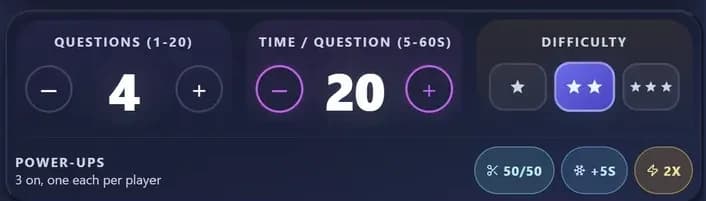
For a party, go shorter than feels comfortable. Ten to fifteen seconds keeps a room loud; thirty gives people long enough to check their phone, and once one table does that the energy is gone. The exception is the round about the birthday person, where the arguing is the entertainment — give that one more room.
Two moments handle the drama for you: the question at the halfway point is worth double if you get it and costs 30 points if you do not, and the last question is worth double for everybody. That second one matters more than it sounds. It means nobody who is vaguely close has stopped playing by the end, which at a party is the difference between a game and an announcement.
The same shape, other occasions
- Anniversary or wedding. Swap round one for how they met, and run the year round on the year they got together rather than a birth year.
- Retirement. Round one becomes their first year at the company. One rule: nothing only the people who were there would know, or you have written a quiz for four people.
- Office party. Drop the personal round entirely and run two generated rounds plus one about the company year. Teams by department, and it will get more competitive than you expect.
- Christmas or new year. The year round writes itself, and everybody has an opinion about the year that just happened.
Questions people ask
How many birthday quiz questions should I write?
Between 15 and 20 in total, across three or four rounds. Under 15 is over before the room settles; past 20 you will be reading questions to people who have gone back to talking. If you only have time to prepare one round properly, make it the one about the birthday person and generate the rest.
What if half the guests have never met the birthday person properly?
Put people in teams rather than playing individually. A team of four where one person knows the answers and three do not is a conversation; four individuals where three are lost is three people on their phones. Mixing the table so each team has one old friend on it does more for the night than any question you write.
How long does a birthday quiz take?
Twenty questions at twenty seconds each is under seven minutes of pure answering, and roughly fifteen to twenty in practice once you add reading them out and the arguing in between. That is about right for a party — long enough to be an event, short enough that it does not become the evening.
Can everyone play on their own phone?
Yes, and nobody needs an account or an app — they open a link, type a name, and they are in. A free room seats 42. If you are over that, put people in pairs on one phone, which is a better party format anyway.
Does this work for anniversaries, retirements and office parties?
The structure does. Swap the first round for how the couple met, or for the retiree first year at the company, and keep the year round exactly as it is. The office version needs one extra rule: nothing that only the people who were there in 2019 could possibly know.
Build the rest of it in a minute
Write the round about them yourself. For the others, type the year they were born and the thing they love, and let the questions be written for you.
Create the QuizFree to host • Guests join with a code, no account • Up to 42 in a free room
More on the format: how to run the perfect quiz night, or what the AI actually does with your topic.